

(Appreciate Gooznews? Help spread the word. Forward this email to friends and colleagues who might like it.)

The Center for Medicare and Medicaid Services earlier this month proposed changes in the physician pay schedule that would result in primary care docs making slightly more money in 2026 while many high-paid specialists would earn slightly less.
Progressives, public health officials and primary care advocates have pushed this reform for many years. Paying more for primary care will allow those docs to spend more time with their patients, time that can be used to manage their care, encourage healthier lifestyles and administer more preventive measures — all of which should lead to reductions in the use of expensive tests, procedures and surgeries.
“We need to try some new ideas to produce health,” Ann Greiner, the chief executive of the Primary Care Collaborative, told the New York Times. “This proposed rule is moving us in that direction.”
Health and Human Services secretary Robert F. Kennedy Jr. raised the issue late last year and to the surprise of many, CMS followed through in this year’s proposed physician payment rule.
But this change can’t be viewed in isolation. If you are a primary doc, does it really matter how much you get paid per visit if a significant portion of your patients stop showing up because they no longer have health insurance? How can you manage care for someone you don’t see?
Starting next year, because of actions by the Trump regime and the Republican Congress, millions of people previously enrolled in Affordable Care Act plans will drop coverage because their premium subsidies have been sharply reduced. Starting in 2027, the just-passed One Big Ugly Bill (OBUB) will force over 10 million people off Medicaid because they failed to fill out the proper paperwork or go through the rigamarole of proving they remain poor even though they are working.
Even poor people on Medicare, the program that covers seniors and the disabled, may opt for reduced primary care coverage in the years ahead. As StatNews reported this morning, the OBUB signed by President Trump will force poor seniors who already receive special help to pay for Medicare Part B, which covers all physician services, to jump through a number of hoops before qualifying for the program.
The Biden administration passed a rule in 2023 that made it easier to sign up for this added help from the Medicare Savings Program. Now, those seniors won’t be automatically enrolled when they are receiving Social Security supplemental income, which only goes to the poorest of the poor. They will also need to resume filing annual reports on their assets. The Congressional Budget Office estimated reinstituting these bureaucratic hurdles will “save” $66 billion over the next decade, which is being used to give more tax breaks to the rich.
You don’t have to be an economist to understand that a slight increase in primary care prices will not make up for the sharp drop in volumes associated with all the cuts in coverage from the OBUB.
The impact on our two-tier system
Not all primary care practices will be harmed by these coverage cuts. If you serve a mostly low-and moderate income clientele who depend on public programs, you will likely to do worse under the combined effect of slightly raised prices on sharply lower volumes.
But if you serve a better-off, well-insured patient population unscathed by the OBUB, you will make more money. Private insurance plan rates generally follow the Medicare physician fee schedule. Indeed, those rates are on average about 43% higher than the Medicare rate.
In other words, primary care docs serving the rich and well insured will get more while primary care docs for the poor will get less. This will come as no surprise to those who understand this is a country where access to health care isn’t a right, but a privilege, one where if you are poor, you must jump through innumerable hoops to earn.
But let’s look on the bright side. The CMS rule, if approved as written, will compound the shift toward higher primary care pay (it’s a complicated formula; as Paul Krugman likes to say, don’t ask). If left in place for a decade, it could make a sigificant dent in the differential between what primary care physicians earn and what the most highly-paid specialists earn, which over the past three decades has risen to more than twice the differential. This could make a huge difference when the political winds change and a more humane Congress and president return America to the path toward universal coverage.
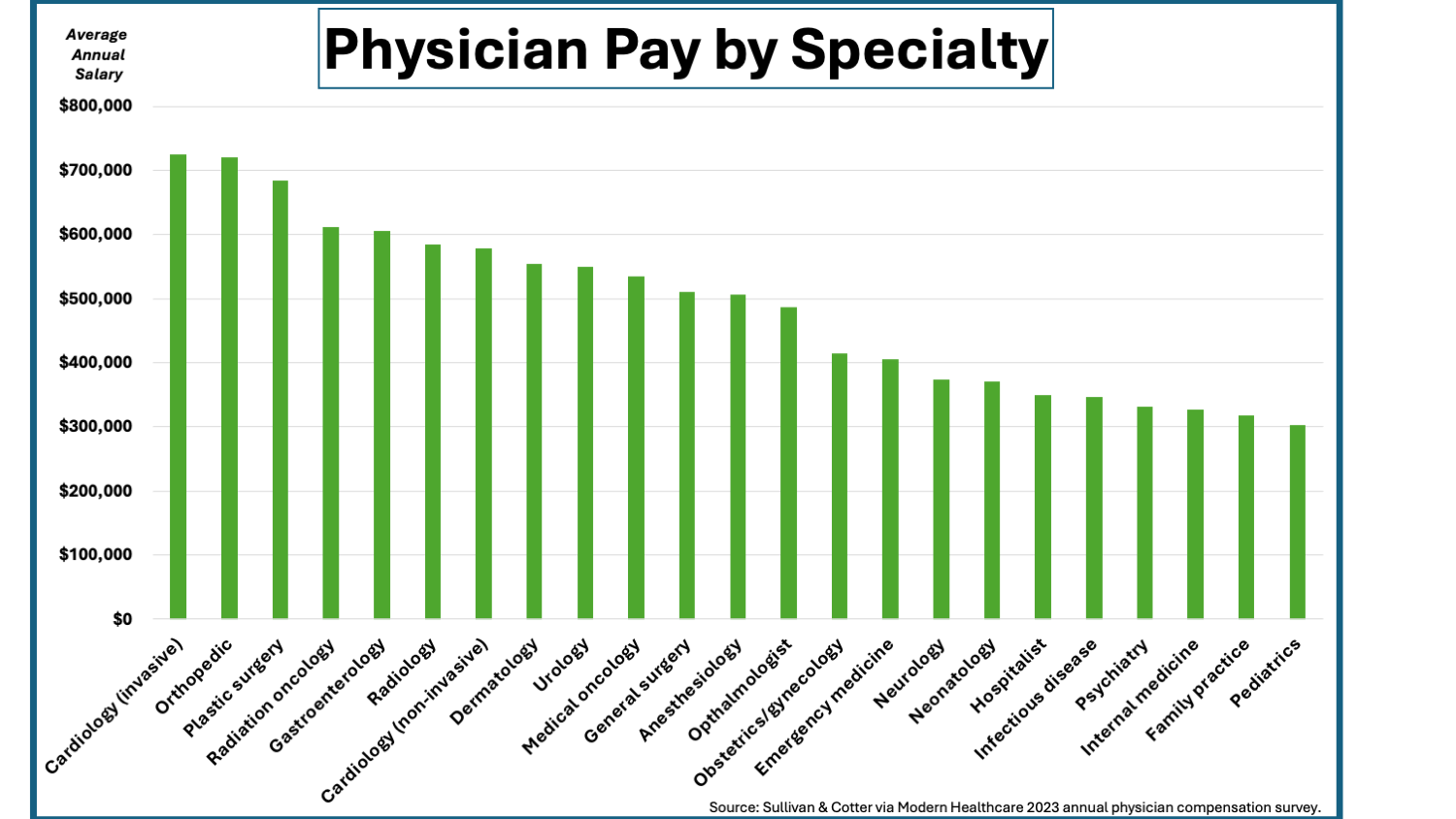
But here’s the rub. The American Medical Association and medical specialty societies are lobbying hard to change the rule, whose comment period remains open until September 12. They have a very selfish reason for wanting to maintain the role played by the AMA’s Relative Value Scale Update Committee (better known as the RUC), which in effect acts as a price setting committee for CMS. As I wrote over three years ago:
The RUC meets three times a year to consider changes and additions to the “relative value” of more than 10,000 billing codes in the Medicare physician fee schedule. Each year, in a textbook example of what economists call agency capture, the Centers for Medicare and Medicaid Services sets physician service prices based almost entirely on the RUC’s recommendations, which systematically overweight technical skills like surgery and underweight the cognitive skills used in primary care. The RUC’s 32-person roster includes one voting member for each of the 27 medical specialties recognized by the AMA.
The AMA also earns fees from use of its proprietary codes in billing software programs. These blatant conflicts of interest have to end.
In a nod in that direction, the proposed rule also asks the public to weigh in on alternative mechanisms for determining the “relative value” of various specialties, which now depend on specialty society surveys of their memberships (another blatant conflict of interest). Here’s a suggestion: CMS should hire professional staff capable of conducting independent, scientific studies of the relative value of different physician specialties that will be fair and free from conflicts of interest.
The AMA and specialty societies’ lobbying campaign against the change is well underway. I expect thousands of comments will pour in protesting the proposed rule. Let’s see if CMS under RFK Jr. and Dr. Mehmet Oz follow through and make this long overdue change.